How to Pack Light for Travel: The Step-by-Step Guide to Carry-On Only Trips


Even Tone Underarm Mist | Brightening Spray for Dark Underarms | 48H Odour Protection | 7% Glycolic + 3% Lactic Acid | Pack of 2 | 100ml
There is a specific kind of travel freedom that only becomes available once you commit to packing light — the freedom to take any flight without checked baggage fees, to move between destinations without lugging a suitcase up four flights of stairs, to walk out of the airport directly into your destination while everyone else waits at the carousel. Once you've experienced it, travelling any other way feels like carrying unnecessary weight in every sense.
Yet packing light is the travel skill most people assume they can't master. Their wardrobe is too varied, their toiletries too necessary, their contingencies too important to leave behind. What they're actually describing is a packing mindset that hasn't yet made the shift from packing for every possibility to packing for what will actually happen — and that shift, once made, permanently changes how you travel.
Learning how to pack light is not about deprivation. It is about precision.
The reason most people overpack is fear — the fear of not having the right thing for an occasion that might arise, the fear of wearing the same outfit twice, the fear of needing something and not having it. This fear is almost never justified by what actually happens on a trip. Most occasions don't arise. Wearing the same outfit twice is invisible to everyone except you. The things you didn't pack can almost always be purchased, borrowed, or done without.
The practical rule that cuts through all of this: pack for what you will actually do, not for what you might theoretically do. If you're going on a beach holiday with one dinner out, pack beach clothes and one dinner outfit — not beach clothes, hiking gear, two dinner outfits, gym clothes, and smart casual options for unspecified occasions. Be honest about your itinerary and pack for that reality rather than the anxiety around it.
The second mindset shift is accepting that you will do laundry. A week-long trip does not require seven outfits if you wash clothes on day three. Most accommodation has laundry facilities or nearby laundry services. Quick-dry fabrics can be washed in a sink and dry overnight. Accepting laundry as part of travel logistics halves your clothing requirements immediately.
The capsule wardrobe approach — a small collection of versatile, interchangeable pieces that work in multiple combinations — is the foundation of packing light for any destination or duration.

Intimate Brightening Roll-On Serum | Inner Thighs & Bum | 10% AHA + PHA | Evens Skin Tone | Lightweight & Non-Sticky | 70ml
The formula that works
Three to four tops that work with every bottom you're packing. Two bottoms — one casual, one versatile enough to dress up or down. One layer — a light jacket, cardigan, or fleece depending on destination. Two pairs of shoes — one for active use, one for everything else. This formula covers most travel scenarios for trips of up to two weeks with planned laundry.
Colour coordination is non-negotiable for light packing
Packing light requires that everything in your bag works with everything else. Build your travel wardrobe around a neutral base — navy, grey, black, white, or khaki — with one or two accent pieces. Every item should be wearable with at least three other items in the bag. A top that only works with one specific bottom, or shoes that only match one outfit, immediately fails the light packing test.
Fabric choices that enable light packing
Merino wool is the single most valuable fabric for light travel — it is naturally odour-resistant, meaning items can be worn multiple times without washing, regulates temperature across a wide range of conditions, and looks presentable enough for most occasions from casual to smart casual. Quick-dry synthetic fabrics offer similar multi-wear capability at lower cost. Both enable you to pack fewer items with full confidence that they'll remain wearable.
Toiletries are where most people's light packing ambitions collapse. The skincare routine, the hair products, the specific products that work for your skin type — they add up to a bag that is heavy, airport security-unfriendly, and disproportionate to what's actually used on a trip.
The travel-size audit
Go through your full toiletry kit and ask honestly: which of these will I use every day? The answer is typically shampoo, conditioner, face wash, moisturiser, sunscreen, toothpaste, deodorant, and perhaps one or two additional specifics. Everything else is occasional use that can be skipped on a trip without meaningful consequence.

Sunscreen Spray for Body | SPF 50+ PA+++ | Sweat & Water-Resistant | Broad Spectrum UVA/UVB Protection | Clear Matte Formula | Aloe Vera | 100ml
Solid products eliminate liquid restrictions
Solid shampoo bars, conditioner bars, and solid face cleansers eliminate the 100ml liquid restriction for carry-on travel while simultaneously being lighter and more compact than their liquid equivalents. A single shampoo bar replaces multiple travel-size bottles and lasts longer per wash than liquid shampoo. For Indian travellers who frequently deal with airport security liquid restrictions, transitioning to solid personal care products is a genuine packing game-changer.
Decanting into travel containers
For products that don't come in solid form, decanting into small travel containers — 30–50ml per product — reduces weight and volume dramatically while keeping only what you'll actually use. Refill after every trip rather than buying new travel-size products, which are expensive per unit and generate unnecessary packaging waste.
The pinnacle of packing light is eliminating checked baggage entirely — travelling with a single carry-on bag regardless of trip length. For most trips under two weeks, this is entirely achievable with the right bag and the right packing approach.
Choosing the right bag
A 40-litre backpack fits within most airline carry-on dimensions and provides sufficient volume for two weeks of light packing. Osprey, Nomatic, and several Indian-market alternatives offer purpose-built one-bag travel packs with laptop compartments, organisation systems, and carry-on-compliant dimensions. The bag should be structured enough to stand independently, have a dedicated document and electronics pocket accessible without opening the main compartment, and be comfortable to carry for extended periods.
Packing cubes — the light packer's essential tool
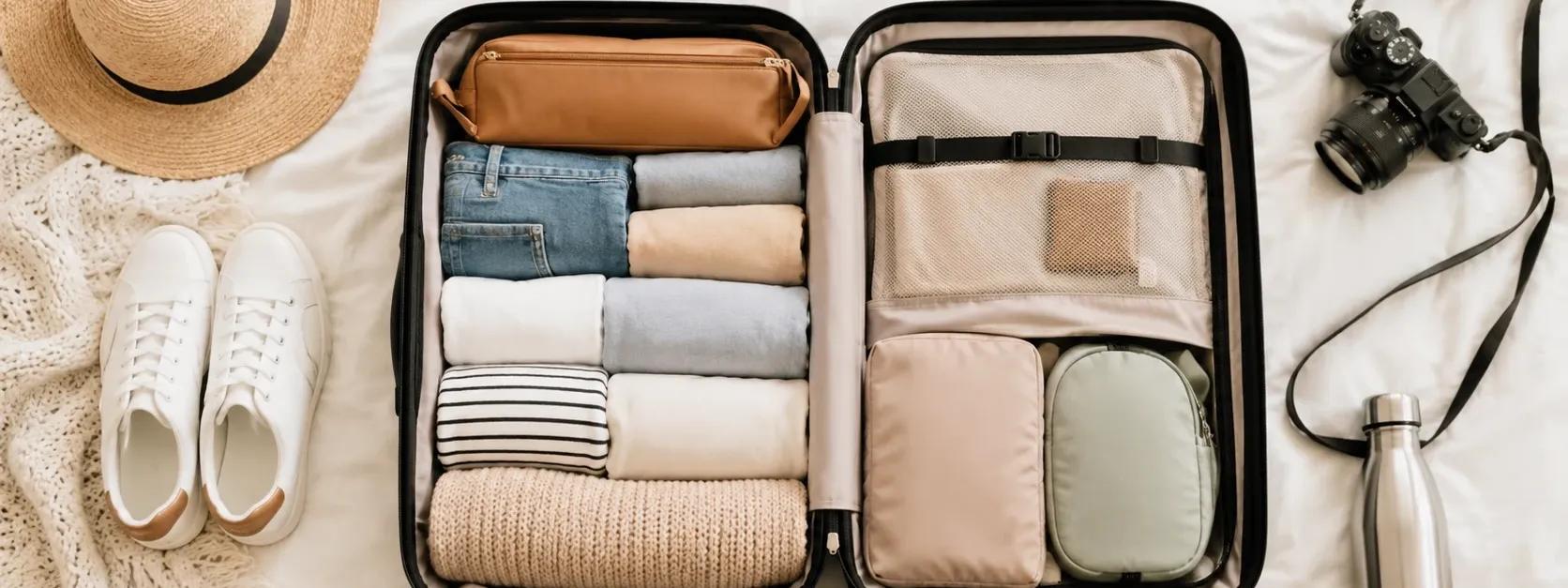
Packing cubes compress clothing into organised, space-efficient blocks that make a carry-on significantly more usable. Separate cubes for tops, bottoms, underwear and socks, and layers eliminate the bag archaeology of finding a specific item buried at the bottom. Compression packing cubes reduce clothing volume by thirty to forty percent — meaningfully expanding effective bag capacity without increasing bag size.

Even Tone Underarm Mist | Brightening Spray for Dark Underarms | 48H Odour Protection | 7% Glycolic + 3% Lactic Acid | Pack of 2 | 100ml
What to wear versus what to pack
Wear your bulkiest items on travel days — your heaviest shoes, your warmest layer, your largest jacket. These items don't count against your luggage allowance while worn and free up significant bag space for lighter items.
Indian domestic travel has specific considerations that shape the light packing approach. The climate variation across India's destinations is extraordinary — you can move from tropical beach destinations to high-altitude mountain locations within a single trip. The layering strategy — quick-dry base layers plus one versatile mid-layer plus one packable outer shell — handles this range in a remarkably compact package.
Train travel — still the backbone of Indian domestic travel — is significantly easier with a small, soft-sided bag than with a rolling suitcase. Overhead luggage racks on Indian trains are designed for bags rather than rigid suitcases. A 30–40 litre backpack is the most practical luggage format for Indian train travel by a significant margin.
How do I pack light for a two-week trip? Apply the capsule wardrobe formula, plan laundry at the midpoint of the trip, use solid toiletries or travel-size decanted products, and use compression packing cubes. Two weeks of carry-on-only travel is achievable for most destinations with three to four tops, two bottoms, one layer, two pairs of shoes, and a compact toiletry kit.
What if I need formal clothes for a work trip? One suit, blazer, or formal outfit can be packed efficiently using the bundle wrapping method — wrapping garments around a central core reduces creasing significantly. Alternatively, for trips where formal wear is required only once, renting or purchasing locally is often more practical than packing formal items that take disproportionate bag space.
Is packing light realistic for Indian weather? Yes — quick-dry fabrics handle India's heat and humidity better than traditional travel fabrics, and the layering strategy covers the temperature variation across destinations efficiently. The main India-specific addition is ensuring sunscreen and mosquito repellent are in your toiletry kit regardless of destination.
