What to Wear to a Beach Vacation in India: The Complete Packing and Outfit Guide


Sunscreen Spray for Body | SPF 50+ PA+++ | Sweat & Water-Resistant | Broad Spectrum UVA/UVB Protection | Clear Matte Formula | Aloe Vera | 100ml
India's beach destinations are among the most diverse in the world — from Goa's internationally influenced party beaches to Kerala's serene backwater coastlines, from Andaman's pristine tropical reefs to Mumbai's urban beaches and Pondicherry's French-quarter shores. Each has a distinct character, a distinct social context, and a distinct set of expectations around beach attire that any packing list needs to account for.
The question of what to wear to a beach vacation in India is therefore more nuanced than it appears — because beach dressing in India involves navigating not just sun protection and comfort but also the cultural diversity of Indian coastal communities, the significant variation in beach culture between tourist-heavy and local beaches, and the practical reality of Indian heat, humidity, and the fact that most Indian beach vacations involve considerably more than lying on the sand.
This guide covers all of it — from beach wear to beach restaurant, from Goa nightlife to Andaman snorkelling, and from the practical to the stylish.
Indian beach culture is not monolithic — the cultural expectations around beach attire vary significantly between destinations and between beach contexts within the same destination.
Tourist-oriented beaches — North Goa's Baga, Calangute, and Anjuna, South Andaman's Radhanagar, Varkala's cliff beaches — have high exposure to international tourists and a correspondingly relaxed attitude to beach attire. Swimwear is normalised on these beaches. Cover-ups are courteous but not mandatory between the beach and adjacent beachside establishments.
Local and family beaches — South Goa's quieter stretches, most Tamil Nadu and Andhra coastline beaches, urban beaches like Juhu in Mumbai and Elliot's Beach in Chennai — have predominantly local users with considerably more conservative cultural expectations around beach attire. Swimwear without cover-ups is unusual and often culturally inappropriate on these beaches. Light, covered clothing in breathable fabrics is more contextually appropriate.
Upscale resort beaches — private beaches attached to luxury resorts at Maldives-style Lakshadweep properties, high-end Goa resorts, and Kerala Ayurveda retreats — operate within the norms of international resort culture where swimwear is entirely standard within the resort property.
Understanding which type of beach context your vacation involves is the foundation of appropriate and practical beach vacation dressing.

Target & Fade Duo for Hyperpigmentation | Even-Tone Underarms, Inner Thighs & Bum | Refines Skin Texture | For All Skin Types
Swimwear — chosen for your beach type
For tourist-oriented beaches where swimwear is normalised, a one-piece swimsuit is the most versatile Indian beach vacation option — it provides the coverage for confident movement beyond the immediate water's edge, works for water activities including snorkelling, and transitions more easily into resort dining with a cover-up than bikinis. Bikinis are entirely appropriate on tourist-oriented beaches and at resort pools — a high-waisted bikini bottom provides additional coverage and photographs well for Indian beach vacation content.
For more conservative beach contexts, a rash guard and board shorts or a burkini-style swimsuit provides the ability to swim comfortably while dressing appropriately for a culturally conservative beach environment. Many Indian women who travel to mixed beach destinations pack a swimsuit for the water and wear their cover-up immediately upon exiting — a pragmatic approach that works across beach contexts.
Cover-ups — the most versatile beach vacation piece
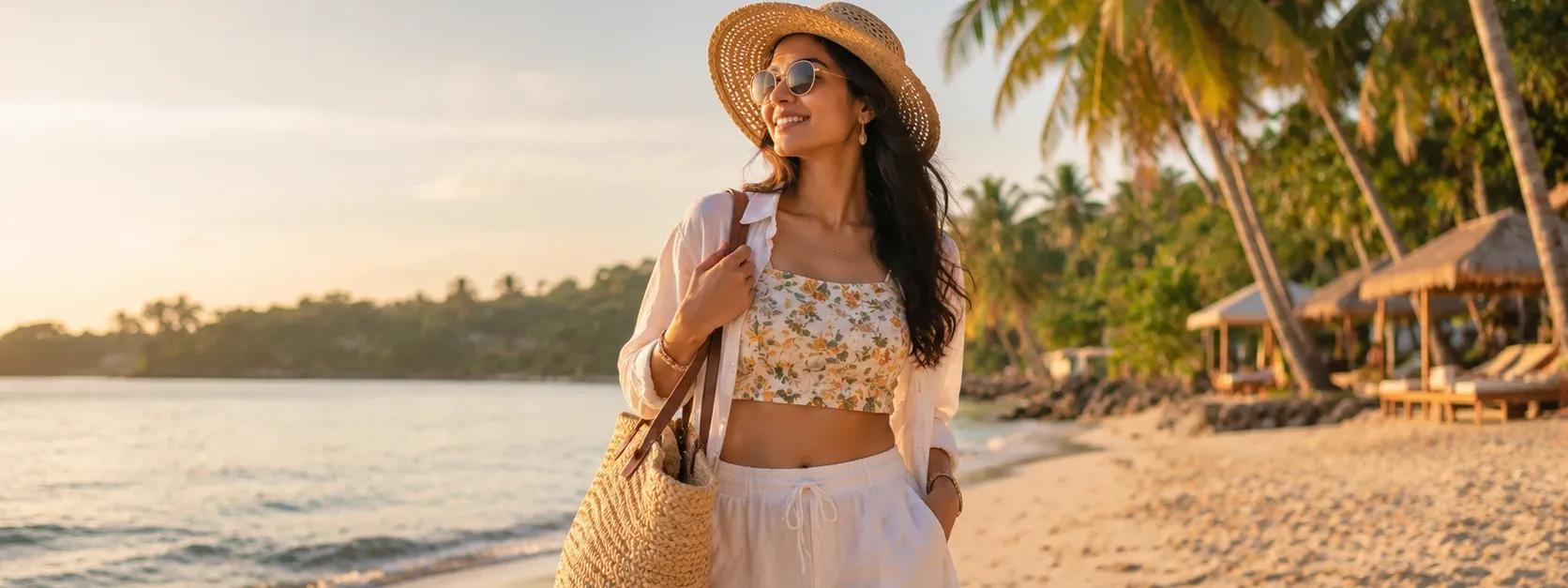
A cover-up — a loose, lightweight layer worn over swimwear — is the most important and most versatile piece in an Indian beach vacation wardrobe. It functions as beach wear, walk-to-restaurant wear, and light protection against Indian beach sun simultaneously. Options range from simple cotton kaftans and sarongs to more structured linen shirts and lightweight dresses. A linen shirt cover-up in a neutral or print — long enough to cover swimwear fully — transitions from beach to beachside café to evening casual with nothing more than a footwear change.
Dresses and casual wear — for beach town exploration
Most Indian beach vacations involve significant time away from the actual beach — exploring beach towns, visiting local markets, eating at restaurants, taking day trips. The casual wardrobe for beach town exploration should be breathable, light, and comfortable in high heat and humidity. Midi and maxi dresses in cotton, linen, or rayon are the most comfortable and most versatile casual beach town wear — they protect against sun exposure while remaining cool, transition from day to evening with accessories, and photograph beautifully in beach town settings.
Printed co-ord sets — particularly the matching shorts and top combination — work well for younger beach vacation styling. Linen wide leg trousers with a crop or fitted top work for slightly more elevated beach town occasions.
Evening wear — for beach restaurant and nightlife
Goa in particular has a well-developed beach nightlife and restaurant culture that requires an evening wardrobe distinct from beach and casual daytime wear. A printed midi dress, a co-ord set in a richer fabric or colour, or a white linen outfit with statement accessories transitions from day to evening effectively. Goa's beach club and restaurant culture accommodates a wide range of dress codes — from very casual to fashion-forward — making the evening wardrobe decision primarily about personal style rather than occasion appropriateness.

Tinted Sunscreen SPF 50 | Makeup-Friendly | No White Cast | Niacinamide + Titanium Dioxide | For Oily, Combination & Acne-Prone Skin | 40ml
For Kerala and more conservative beach destinations, evening dressing is more conventional — a kurta set, a midi dress, or a smart casual outfit for the restaurant dinner is appropriate.
Goa
Goa's beach fashion culture is the most relaxed and internationally influenced of India's coastal destinations. Swimwear is standard on most Goa beaches. Casual summer dresses, linen sets, and printed beach clothes dominate Goa's daytime beach town aesthetic. Evening options range from bohemian maxi dresses for North Goa's flea market culture to more polished outfits for South Goa's upscale restaurant scene.
The Goa beach vacation wardrobe: two swimsuits or swimwear pieces, two to three cover-ups including a linen shirt and a kaftan, three to four casual dresses or co-ord sets, one to two evening options, and comfortable sandals for day with flat evening sandals.
Kerala
Kerala's beach culture — calmer, more nature-focused, less party-oriented than Goa — calls for lighter, more modest beach dressing. Varkala's cliff beach has some tourist beach culture normalising swimwear; most Kerala beaches suit covered beach clothes. Light cotton kurtas, linen sets, and comfortable midi dresses in breathable fabrics suit Kerala's beach vacation aesthetic and its blend of beach time and backwater, cultural, and Ayurveda experiences.
Andaman
Andaman's beaches — particularly Radhanagar on Havelock — are international tourist-oriented and swimwear-normalised for beach and water activity use. The vacation is heavily activity-oriented — snorkelling, scuba diving, island hopping — which requires practical swimwear that accommodates water sports. A rash guard provides sun protection during extended snorkelling without requiring reapplication of waterproof sunscreen. Island-hopping days between activities suit comfortable casual clothes — shorts, t-shirts, light dresses — that transition from boat to beach to dining.

Better Daily Essentials Set | Cleanser, Moisturizer & Sunscreen | Daily Skincare Routine | Hydration, Protection & Care
Sunscreen is the most important beach packing decision
Indian beach sun — particularly the intense Andaman and Goa sun — requires SPF 50 in adequate quantity, applied thirty minutes before sun exposure and reapplied every two hours of active beach time. Most Indians significantly underapply sunscreen — a quarter teaspoon per application for face and neck, a full tablespoon for body coverage. Pack significantly more than you think you'll need — running out mid-vacation and relying on hotel gift shop sunscreen at premium prices is a common and avoidable beach vacation problem.
Footwear for beach vacations
Flip flops for beach use. Flat leather or woven sandals for beach town exploration and restaurant dining. Comfortable closed shoes for any beach destination activities — hiking, cycling, temple visits — where flip flops are inadequate. Avoid packing heels for beach vacations unless the specific itinerary includes an occasion that definitively requires them — heels and beach town surfaces, including cobblestone Goa lanes and uneven Kerala backwater town streets, are incompatible in practice.
Hat and sunglasses
A wide-brimmed hat provides the sun protection that SPF alone cannot cover during extended beach time — face and neck sun exposure at Indian beach latitudes produces visible sun damage far faster than equivalent temperate climate sun exposure. A quality pair of UV-protective sunglasses is equally important. Both also photograph well and contribute to the beach vacation aesthetic that most Indian travellers are pursuing.
Is it appropriate to wear a bikini on Indian beaches? On tourist-oriented beaches at Goa, Andaman, and similar destinations, yes — bikinis are common and culturally unremarkable. On local and family-oriented Indian beaches, swimwear without coverage is culturally inappropriate and likely to attract unwanted attention. Reading the specific beach's context — predominantly tourist or predominantly local — is the appropriate guide rather than a blanket rule for all Indian beaches.
What is the most versatile piece for an Indian beach vacation? A linen shirt cover-up in a neutral or print covers the widest range of beach vacation occasions — beach cover-up, walk-to-restaurant wear, casual sightseeing layer, and light sun protection simultaneously. A single well-chosen cover-up worn over swimwear or paired with shorts or a bikini bottom covers most casual beach vacation dressing needs.
How do I dress for a beach vacation in Indian heat without being uncomfortable? Natural fabrics — linen, cotton, and rayon — breathe significantly better than synthetic fabrics in Indian beach heat. Loose silhouettes allow air circulation. Light colours reflect rather than absorb heat. Minimal layering during peak daytime heat hours (11 AM to 3 PM) is the practical approach — save any covered outfits for mornings, evenings, and air-conditioned restaurant contexts.
