Office Wear Trends for Women India 2026: What to Wear, What to Buy, and What's Out


Target & Fade Duo for Hyperpigmentation | Even-Tone Underarms, Inner Thighs & Bum | Refines Skin Texture | For All Skin Types
The Indian office has changed more in the last five years than in the previous twenty — and the dress code has changed with it. The rigid formal wear of pre-pandemic corporate India — saris and salwar suits in traditional offices, Western business formal in MNCs — has given way to a considerably more nuanced and considerably more interesting landscape. Hybrid work, the rise of creative industries, the influence of global fashion on Indian professional culture, and a generation of working women who refuse to separate professional credibility from personal style have all contributed to an office fashion environment that is simultaneously more relaxed and more considered than anything that preceded it.
Understanding what that environment looks like in 2026 — which trends are defining Indian office fashion this year, how they translate across different workplace cultures, and how to build a work wardrobe that is both trend-aware and professionally appropriate — is what this guide addresses.
Indian office wear in 2026 exists in three distinct registers that require different approaches.
Traditional corporate environments — banking, law, government-adjacent roles, established family businesses — retain a preference for conventional professional dress: saris, salwar suits, or formal Western wear in conservative colours and modest silhouettes. These environments have not moved as dramatically as tech and creative workplaces, and dressing to their specific cultural expectations remains professionally important.
Tech and startup environments — the dominant employers of India's younger professional class — have moved firmly into smart casual territory where the distinction between work wear and premium casual wear is increasingly minimal. Here, office fashion is more personal expression within professional parameters rather than adherence to established dress codes.
Creative, media, and fashion industries — where office wear is itself a portfolio of taste and personal brand — permit the widest range of expression and where being on trend is an implicit professional expectation rather than a personal indulgence.
The office wear trends of 2026 serve all three registers, but with different intensity and interpretation.

Intimate Brightening Roll-On Serum | Inner Thighs & Bum | 10% AHA + PHA | Evens Skin Tone | Lightweight & Non-Sticky | 70ml
Elevated basics — the workwear foundation
The elevated basics trend — investing in simple, well-cut pieces in quality fabrics rather than trend-specific statement items — has become the dominant approach in Indian professional women's wardrobes. Tailored wide leg trousers in neutral tones — camel, charcoal, ivory, and olive — worn with fitted turtlenecks, structured shirts, or quality knit tops form the foundation of the 2026 Indian professional wardrobe. The investment in a few genuinely well-cut basics — trousers that break correctly at the ankle, a blazer that fits through the shoulder, shirts in fabrics that don't pill — produces a wardrobe that looks professional consistently rather than occasionally.
The return of the blazer — reimagined
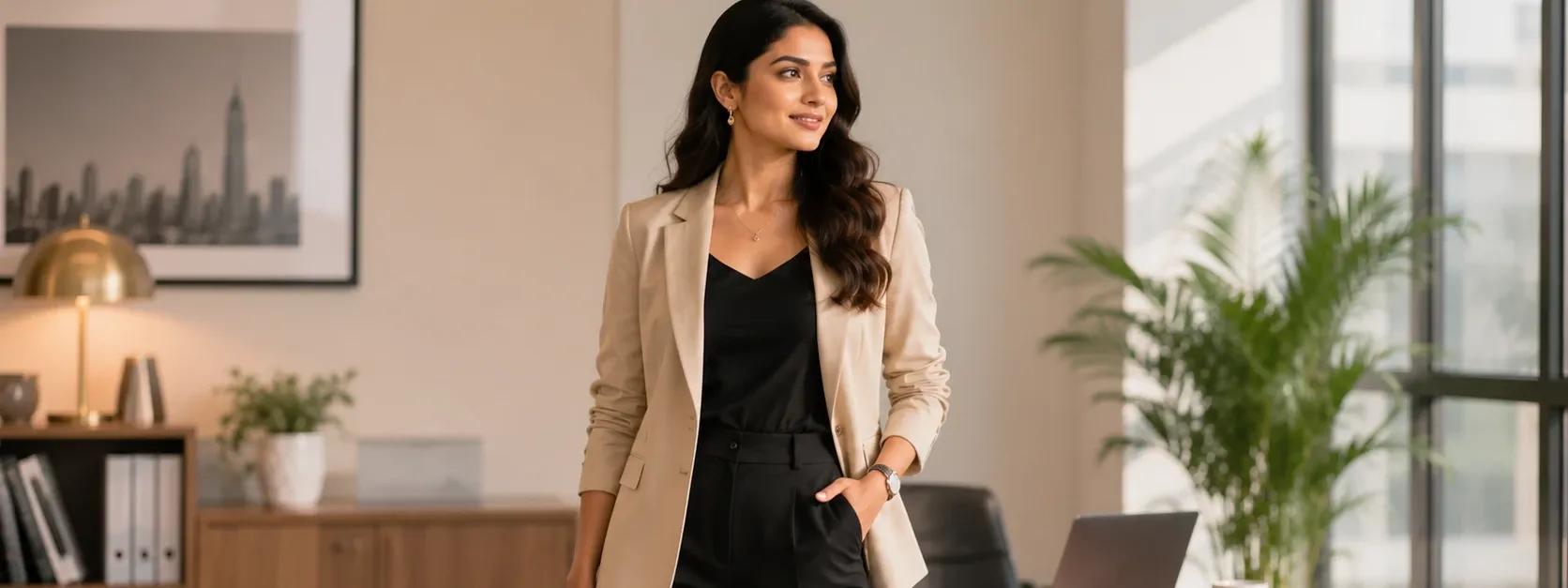
Blazers have returned to Indian office fashion with significant force in 2026 — but not the boxy, corporate blazers of the early 2000s. The current iteration is oversized and slightly relaxed through the shoulder, worn as a top layer over anything from tailored trousers to wide leg jeans in smart casual environments. Textured fabrics — bouclé, linen, structured cotton — in colours beyond the conventional navy and black are defining the 2026 blazer: terracotta, sage green, and dusty rose blazers in structured fabrics are among the most visible office wear pieces this year.
Sari reimagined for the modern Indian office
The sari has experienced a significant renaissance in Indian professional fashion — not in the conventional formal register but in a contemporary, easier-to-wear interpretation. Linen and cotton saris in muted, sophisticated palettes — slate blue, warm beige, rust, deep olive — draped in simplified styles and paired with structured blouses and low heels are being adopted by working Indian women across industries as a distinctly Indian professional identity that no Western silhouette can replicate. The contemporary office sari is not a traditional occasion sari — it is a daily workwear proposition that signals cultural confidence and professional polish simultaneously.
Trousers over everything
Wide leg trousers and straight leg trousers in structured fabrics have comprehensively replaced pencil skirts and straight-leg formal trousers as the Indian professional woman's bottom-half default. The wide leg trouser in 2026 Indian office fashion comes in tailored crepe, linen blends, and structured cotton in a range of office-appropriate colours — and its ability to be dressed up with a blazer and heels or down with a quality knit and loafers makes it the most versatile workwear investment available.
Quiet luxury aesthetics

Even Tone Underarm Mist | Brightening Spray for Dark Underarms | 48H Odour Protection | 7% Glycolic + 3% Lactic Acid | Pack of 2 | 100ml
The quiet luxury trend — minimal branding, quality fabrics, considered cuts, muted palettes — has translated to Indian office fashion in 2026 as a shift toward investment pieces in neutral and muted tones over fast fashion trend pieces. Beige, ivory, oatmeal, soft grey, warm white, and dusty rose are the palette of quiet luxury office dressing — worn in clean silhouettes without excessive embellishment or visible logos.
Contemporary Indian fusion
The fusion of contemporary silhouettes with Indian textile traditions — a structured bandhani blazer over tailored trousers, a phulkari-embroidered structured jacket as a statement layer, handloom cotton shirts in traditional weaves worn with wide leg trousers — represents one of the most distinctly Indian office fashion directions of 2026. It positions Indian textile heritage as a sophisticated professional choice rather than an occasional cultural gesture.
The capsule wardrobe foundation for Indian office wear
Three to four pairs of well-cut trousers — one wide leg in neutral, one straight leg in dark navy or black, one in a colour or texture — provide the bottom-half foundation of a versatile professional wardrobe. Two to three blazers — one classic in navy or charcoal, one in a trend colour or texture — layer over everything. Five to six tops — fitted turtlenecks, structured shirts, quality knits — rotate beneath both. One to two saris or kurta sets for days requiring specifically Indian professional dressing. Two pairs of work-appropriate shoes — a heel and a loafer or pointed-toe flat — cover the full occasion range.
Fabric investment over quantity
The defining characteristic of successful 2026 Indian professional wardrobes is fabric quality over quantity — fewer pieces in genuinely good fabrics that maintain their appearance across repeated wear, rather than more pieces in fabrics that look tired within a month. Linen, wool crepe, structured cotton, quality polyester blends that don't pill, and natural silk alternatives all maintain their professional appearance consistently. This investment approach aligns with the quiet luxury aesthetic that is driving 2026 Indian office fashion.

Even Skin Duo for Hyperpigmentation | Even-Tone Inner Thighs, Knees, Neck & Elbows | Works on High-Friction Zones | For All Skin Types
For client meetings and presentations
A blazer over a fitted top with tailored trousers or a structured midi dress conveys authority and preparation. Colour is acceptable — a cobalt blue blazer or a terracotta structured dress signals confidence as effectively as it signals style. Footwear should be polished — heeled mules, structured pumps, or pointed-toe flats rather than sneakers or casual sandals.
For regular office days
Wide leg trousers with a quality knit or structured shirt and loafers or block-heeled sandals are the smart casual daily uniform of 2026. This combination requires minimal morning decision-making when a capsule wardrobe of these pieces in compatible colours is well assembled.
For office events and work social occasions
An embroidered or printed kurta set, a contemporary sari, or a slightly more elevated Western look — midi dress in a quality fabric, or a textured blazer over tailored trousers — navigates the specific Indian professional social context where completely informal dress is never quite appropriate.
What colours are appropriate for Indian office wear in 2026? The 2026 palette has moved significantly beyond the conventional navy, black, and grey of traditional Indian corporate wear. Muted earth tones — terracotta, sage, camel, dusty rose — are widely appropriate across Indian workplaces. Rich jewel tones — cobalt, emerald, burgundy — are professional in most environments. Bright neons and very casual prints are better reserved for creative industry workplaces.
Are wide leg trousers appropriate for formal Indian offices? In well-structured fabrics — tailored crepe, ponte, or structured linen — and worn with appropriate footwear and top, wide leg trousers are appropriate in most Indian office environments including moderately formal ones. Very conservative environments — certain legal, government-adjacent, and traditional corporate settings — may still favour straight leg formal trousers.
How do I build a professional Indian office wardrobe on a budget? Prioritise bottoms and blazers over tops — the top is the easiest element to vary and the least expensive to replace. Invest in one or two quality blazers and two or three good trousers, and rotate more affordable tops beneath them. Look for Indian brands like W, Anouk, Aurelia, and Biba for work-appropriate Indian wear at accessible price points.
